ANCIENT. OLD. BYGONE. PAST .FORMER. HISTORICAL.
Belonging to a generation who is awakened by technology wherein innovations and restorations may easily take place sways one’s inquisitive mind and be unshakable. Most of the people might know that historical heritages preserves not only the buildings of the past but also the stories behind it. It is true that it may be more efficient to build new buildings than to restore however the memory it keeps is irreplaceable.
There are many places in Manila that was ruined during the second world war and one of these is the Street of Escolta which was known as “The Queen of Streets” it was entitled to be the sleepy residential and market town during the 16th century yet as of the early 20th century it became the Philippine’s premier central business, art, cultural and shopping district. It caters Art Deco, Neoclassical and Beaux Art style of architecture in which some were demolished to pave way for the post-war reconstruction. Most of it were reprieved and recreated but some of it were still deteriorated because of continuous negligence.
The feeling you undergo while walking in the boundaries of Escolta is truly nostalgic. Its like you get a chance to time travel. Allow me to take you with my journey in roaming to the pavements and infrastructures of one of the Manila’s pride, Escolta.
Going in the district downtown of Binondo, Manila I was overwhelmed with the looks of the street, I was welcomed by the enormous building of Don Roman Santos Building.
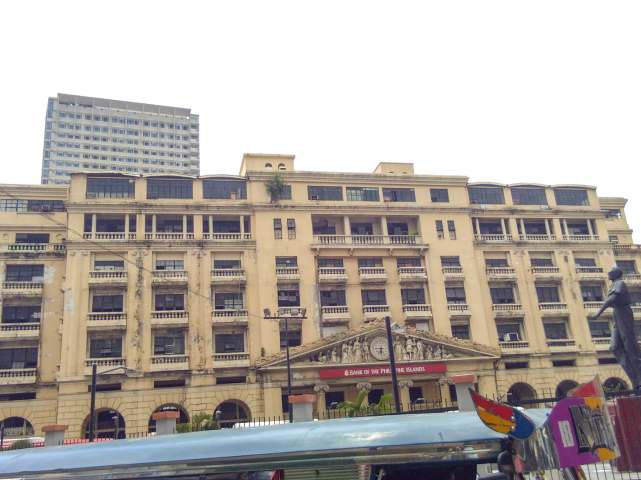
Its location is on the front part of Plaza Lacson and as you can see it is a vast structure so it is ineluctable. It was said to be that this building first aided as the headquarters of Monte de Piedad Savings Bank then it housed as the American Red Cross Hospital during the Second World War and later on renovated in the 1957 and now serves as the Bank of the Philippine Islands. This building incorporates Neoclassical and Renaissance Architectural Style.
The building contains a Greek’s style facade and ionic columns it also shows balance as you can see that it has an equal distribution of windows as well as the division of the building. Proportion was also exhibited as it is comfortable for humans to make use of its space.


These are the things that you can see in the forepart of the building, you can see that it also include arch and it is undeniable that it is slowly dilapidating. It also shows a programmatic system as it is functioning for economy.
As we go on, we encountered the Natividad Building or the TEOFF Center
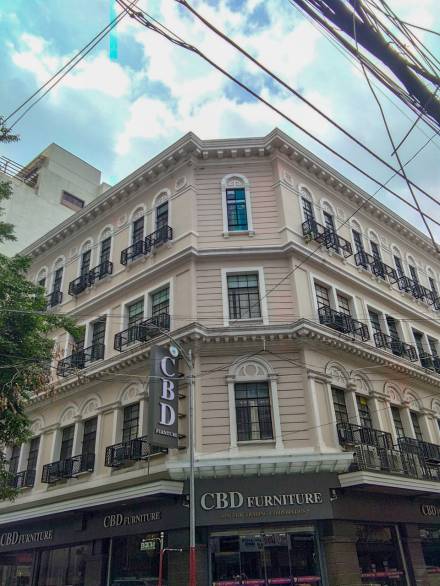
It is one of the remaining buildings in Escolta that has a Beaux Art Style created by Fernando de la Cantera Blondeau. It was former known to be the Philippine Education Company (PECO) which used to be the largest book firm in the Philippines. It was fortunate that the war did not wiped it out and have only minor damages so after the Battle of Manila in 1945 it was rebuilt and reconstructed.
This building displays the principle of balance and it has a stone surround windows which is traditional.
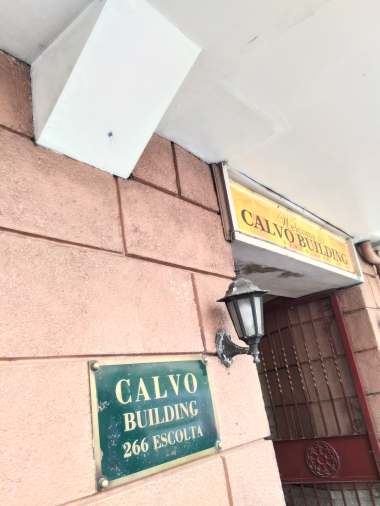
We also saw the Calvo Building it was named after its owner Donya Emiliana Mortera Calvo. This is where the the first broadcast of DZBB took place. Today, the Calvo Building houses the Escolta Museum. You now know the surface story of this building so let me take you inside.
These are few of the things you can see inside the museum, there are old news papers, film posters, bottles, paintings and pictures. Sadly I didn’t get to take a picture of the whole building externally, fortunately, I was able to take a pic of it’s interior which has a false ceiling and an embossed style wall (Figure 4)
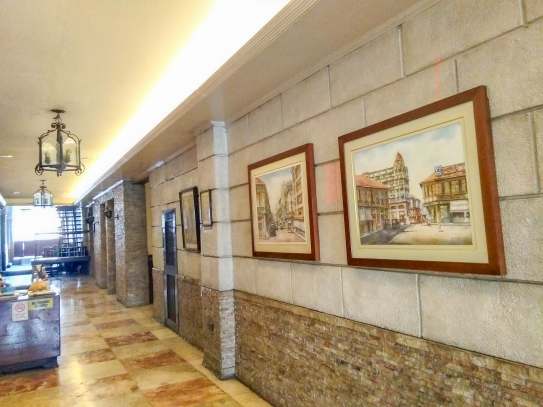
Figure 4: Interior of Calvo Building
The building’s facade has a ribbon style in it,proving that it is surely an old structure because nowadays it is not used anymore. And trivia, in accordance to John Ruskin the ribbon style can be related to death.

And have you heard about the Capitol Theatre? It is now set to be demolished. This is not the first time we went to Escolta, and we were shocked that when we came back we saw the signboard that it is to be demolished.


The Capitol Theatre was designed by Juan Nakpil who is a National Artist for Architecture and Francesco Ricardo Monti it integrates the Art Deco style with strong geometric figures. It was said to be that the building’s interior spaces made use of Sampaguita as its central motif to promote the country’s national flower which was incorporated in a wrought-iron grills but we weren’t able to see it because we cannot go inside. The building’s facade has an art deco grillwork in the center with squares and circles that has two pilasters on both sides.
The theater shut down when the people preferred to watch in modern theaters with air condition inside malls.
And to end this trip, here is The First United Building


It was previously known to be Perez-Samanillo Building (Edificio Luis Perez Samanillo) named after its former owner Luis Perez Samanillo. From its rectangular forms, geometric decoration and straight lines it is clear that it caters the Art Deco style. Its main entrance gate were made from grill works and the alignment of shapes were compact, the facility has a conceptual level as it caters figuration as for its details Clearly, you can see that it’s beauty is remarkable looking from it’s outside appearance and when you go inside,


you will be welcomed by a ceiling with cornice and walls with embossed ribbons. This building was said to house the headquarters of the business owned by Perez Samanillo and also Berg’s Department Store however, as of today, it has a mini museum and a shopping place inside which caters filipino made items which is “The Hub”.


Innovations are not bad. We should always be open for improvements nonetheless, we should not forget our roots. The Buildings of Escolta resembles the ideology of Vitruvius, firmitas (strength), utilitas (functionality), and venustas (beauty). These buildings survived the bombing in the Second World War, before they were simple yet functional and they have proven that they are sturdy as they stood still up to this day and it was like they were given a second chance. Let us not neglect their importance as they hold within their walls the history the people need to know. And that’s it for this trip hope you enjoyed and felt like the way I felt.

 Dennise Sigua